" />

Nifty PE ratio, P/B, Dividend yield charts

Nifty PE ratio chart Sengukoi.com

Downloads

1) Nifty PE, P/B, dividend yield (excel workbook)

2) 14 Years Nifty PE, P/B, dividend yield (plain chart)

3) 14 Years Nifty PE, P/B, dividend yield (analysis chart)

NSE Website

View latest Nifty PE, P/B, dividend yield on the NSE website

Introduction

Nifty is a widely followed Indian stock market index comprising of the 50 largest publicly traded companies in India.

What is PE ratio?

PE ratio refers to price to earnings ratio. It is a widely used and simple ratio used to determine how cheap or expensive a stock/index is either historically or in the future (forward earnings), compared to its peers. More »

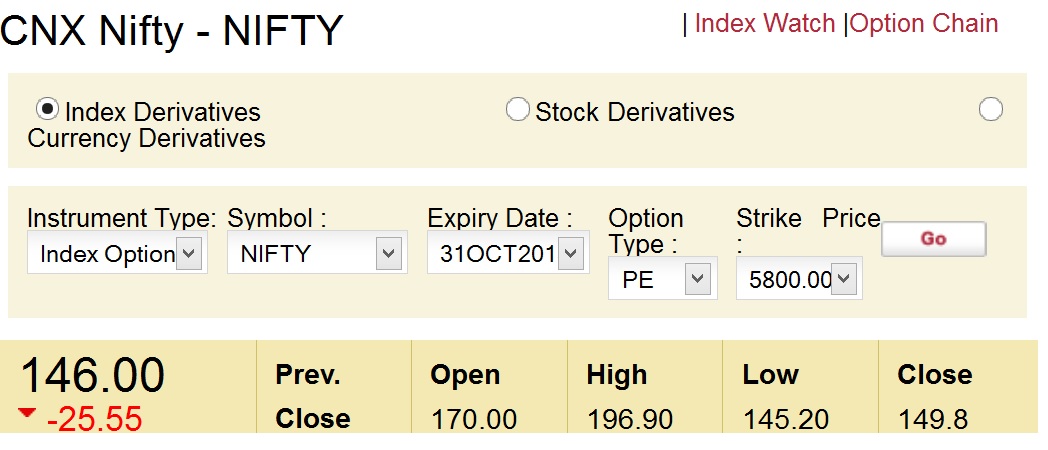
2994421437_e9f337b4d5Life is like an out-of-the-money options contract.

The premium is high at the beginning of the contract (at birth) and inevitably reaches zero as we age and die.

The volatility (ups and downs in our life) will change the premium temporarily, but time decay (ageing) slowly but maturely overpowers it.

For some, at critical events in their life, the premium may rise, even more that what it was at birth.

Some people, then bet that the premium will continue to rise while others who are more pessimistic will look to short us.

At any point of time, there will always be individuals looking to short us while friends, family and even strangers continue to believe in us.

While the price of our options premium varies greatly as we live, we must pay more attention to the underlying because that is the one that actually is unaffected by time decay and truly represents the intrinsic value of our life’s option.

Image credit – Jo@net

BoursaMost liquid index and stock options on the NSE

I had done a little research of my own yesterday (17th April 2013) and reviewed the 140 odd stock options available on NSE (National Stock Exchange, India). I spend around 30 seconds looking at each one of them on the NSE website and tried to categorize them into Tiers based on how liquid they are. As the Tier number increases, the liquidity (number of contracts traded each day) goes down. For example, Tier 1 stock options are more liquid than Tier 3 stock options and so forth.

Most liquid index options on NSE

Nifty, Bank Nifty

Most liquid stock options on NSE

Tier 1 (>2000 Contracts/day – 5)
Infosys, SBI, ICICI Bank, Reliance Industries, DLF Ltd More »

4111211837_a3a6f7e255Are EMA Crossover signals profitable?

This post is going to be slightly different from my previous posts. Instead of continuing with the articles on mutual funds, I’ll be talking about an experiment in technical analysis (a form of market analysis) I had done today. It basically involves seeing if EMA crossover signals (a technical analysis indicator) are of any use at all?

Are EMA crossover signals profitable?

Introducting the Experiment

The following experiment involves backtesting and analysing the EMA crossovers seen on the S&P CNX Nifty (the Indian stock market index) over the past three years.

By doing this backtesting, I tried to answer a curious question I had a few days back – What would happen if an individual trades only on the basis of EMA crossover signals generated? Would that be profitable? More »

8463683689_baa33ca431What is the Money Market? An Introduction – Part 2 of 2

Certificate of deposit

Most of the confusion surrounding certificate of deposit comes from the fact that its called by various names in other countries. For example, in

  • India it goes by the name of – Fixed deposit
  • UK – Bond
  • Australia, New Zealand – Term deposit
  • USA – Certificate of deposit/ Time deposit.

Certificate of deposit is basically a “certificate” issued by banks. The certificate among other things mentions the interest which the bank pays on the deposit and the time period after which the deposit can be withdrawn (premature withdrawal usually warrants a penalty).

A typical transaction involves an individual going to the bank to deposit his money for a fixed period of time (say 3 years) at a fixed interest rate (say 1.450% APY – Annual Percentage Yield) and the bank in return gives him a certificate of deposit with all the details. More »

8474532085_6d010ee8d0What is the Money Market? An Introduction – Part 1 of 2

The money market is basically one of the component of the financial markets. The key feature of the money market is that at its fundamental level it involves trading of financial instruments which are

1) Debt based
2) Short term in nature (maturing in a year or less) and
3) Traded OTC (Over the counter) i.e. not on an exchange.

A typical money market transaction involves an entity (either a large corporation, a bank or the government) borrowing money and in exchange giving an IOU to the lender. The IOU among other things specifies when the amount which was borrowed needs to be repaid (usually ranging from overnight repayment to a year) and at what interest. More »

3484657288_e908985f13Introduction to Mutual Funds – Types Of Bond Mutual Funds

In the previous article we had seen about stock (equity) mutual funds in detail. In this article, lets continue from there and explore the various types of bond mutual funds.

Bond mutual funds invest in a type of fixed income securities called bonds. Investing in bonds is generally considered less riskier than investing in stocks as they are less volatile and provide regular income in the form of interest payments. Hence bond mutual funds are quite popular among the risk averse investors. (Individuals who don’t like to take too much risk). Bond funds constituted about 25% of the total mutual fund assets in the US in 2011 (year end) thereby being the second most preferred type of mutual funds after equity mutual funds. [1]

In this article, lets see about the various types of bond mutual funds. Continuing with our previous tradition we will do so by asking a few questions.

Question 1

Does the bond fund invest in domestic bonds or does it invest in bonds of foreign companies?

Depending on which we have
1) Domestic bond mutual funds
2) Global/World bond mutual funds More »

218842717_1b67a87c8dIntroduction to Mutual Funds – Equity/Stock Mutual Funds

In the previous article we had broadly seen how to conceptually classify a mutual fund. One of the questions we asked while classifying a fund was the asset class in which it invests. Does it invest in stocks, bonds, money market instruments or does it diversify across more than one asset class? One of the most popular asset class in which mutual funds invest is stocks/equity.

In this article lets continue from where we left and see the types of equity/stock mutual funds in detail. Its interesting to note that a large proportion (around 48% in 2010) of mutual fund assets are invested in equities. Other asset classes like bonds, money market instruments constitute the rest (around 52% in 2010).

Why do a large proportion of mutual funds invest in stocks?

This is because equities have had a long history of outperforming almost every other asset class by giving the best returns over longer periods of time. There are some exceptions but its a good rule of thumb that investing in stocks is one of the best options for someone looking for long term investments. More »

5705329601_c6ce8c051aIntroduction to Mutual Funds – Types of mutual funds

Article number 4 in the mutual fund series (For the previous article – Disadvantages of mutual funds)

Classifying mutual funds is always a nightmare. There are tens of thousands of mutual funds out there and trying to classify them into a fund type would be very difficult. However broadly and conceptually we can classify any mutual fund by asking ourselves the following five questions

Question 1 – Does the mutual fund invest exclusively in one asset class (like stocks only fund, bonds only fund, money market instruments only fund, Gold/commodity only fund?) or does it diversify across asset classes (say 60% stocks, 20% bonds, 10% gold, 10% money market funds or something like that)? More »

2191130107_1781536f79Article Number 3 in the Mutual fund series (For the previous article click here)

In the previous article I had briefly pointed out some of the benefits that mutual funds have to offer. As a brief recap we had seen that mutual funds are beneficial because they are basically managed by professionals, some of them are well diversified and hence less risky, comparatively they cost lower and are convenient. Unlike hedge funds, they are quite transparent and well regulated. There is no shortage in the variety of mutual funds and suit pretty much any investors need. We had also seen that equity oriented funds are quite liquid and provide greater returns but at a greater risk. Finally we had seen the SIP as a wonderful way of investing for those who don’t or can’t invest at one go (lump-sum).

In this article lets see some of the disadvantages of mutual funds.

1) Losses are uninsured, Market risks are real

We had seen in the previous article that mutual funds are well regulated (by the SEC in USA and SEBI in India). However one must remember that they are not insured. Investing in stocks via mutual funds doesn’t provide you with any insurance against losses. If the funds NAV decreases, you lose money for real and there is no compensation or insurance.

However, we must realise its in the very nature of the markets to be uncertain and unpredictable (to an extent). Since we expect higher returns while investing in mutual funds (than say risk free treasury bonds) we must similarly expect a higher risk as well. Risk and reward are usually considered two sides of the same coin.

2) Over diversification? “Diworsification”

Diversification to an extent is good in that it reduces the overall risk of the portfolio but what happens when we do too much of it? It ends up substantially reducing the returns thereby defeating the purpose of investing in mutual funds. More »